
FAQ
Your Questions, Our Answers
Do you have questions about our services or tree maintenance? Here are the answers to the most frequently asked questions we receive from our customers in the Laurentians.
When is the best time of year to have a tree cut down?
Tree removal can be done year-round, but late fall and winter are often preferred. The absence of foliage provides better visibility, and the tree contains less water, making it lighter and easier to manage.
That said, when a tree becomes dangerous, it must be dealt with as quickly as possible, regardless of the season. To learn more about our process, visit our Tree Removal page.
When should you have your trees pruned?
Pruning can be done year-round without risking damage to the tree, provided that best practices are followed. Pruning is easier to perform during dormancy, either in early spring or late fall, when the tree's structure is clearly visible.
At Émondage Évolution, we mainly work in the summer when the leaves have come out, which allows us to better assess the condition of the tree. Discover our pruning services.
How do I know if my ash tree is infected with the emerald ash borer?
The presence of the emerald ash borer is difficult to detect early on. The first symptoms can take up to three years to appear.
Signs include progressive dieback of the crown, bark loss, leaf loss in certain sections, and the presence of small D-shaped holes in the trunk. If you suspect an infestation, contact us for an assessment.
What is the forest tent caterpillar and is it dangerous to my trees?
Forest clearing moths are one of the most well-known forest pests, widespread throughout North America. These caterpillars feed on leaves as soon as they form in May and can completely defoliate trees.
Even when severely affected, trees generally withstand infestations that last no more than three consecutive years. However, if the epidemic persists, repeated defoliation can weaken trees and increase their vulnerability to other disturbances.
What to do with the stump after cutting down a tree?
After felling, you have two options: leave the stump in place or have it removed by stump grinding. Stump grinding completely clears the space and allows you to use your land for planting grass, landscaping, or building.
If the stump is not removed, it can attract insects or start to rot over time. For more information, see our Stump Removal page.
Do I need a permit to have a tree cut down?
In most municipalities, a permit is required to cut down a tree whose trunk reaches a certain diameter, generally 5 cm measured 1.3 m above the ground. Regulations vary among municipalities in the Laurentians.
We recommend that you check with your municipality before proceeding. Our team can guide you through the process if necessary.
What is the difference between pruning and trimming?
Pruning involves removing dead, diseased, or unwanted branches to promote the health of the tree. Trimming, on the other hand, is done to control the shape of the tree, clear areas of the property, or improve its appearance.
The two practices are complementary and contribute to the health and safety of your trees. See our Pruning and Trimming pages for more details.
Do you clean up the property after the work is done?
Yes, thorough cleanup of the site is part of every job we do. We remove wood, branches, and debris. Our goal is to leave you with a clean site, as if we had never been there.
Do you offer free estimates?
Yes, all our estimates are free and non-binding. We travel throughout the Laurentians to assess your situation and offer you a solution tailored to your needs. Contact us to make an appointment.
Glossary: Terms to Know
Stump
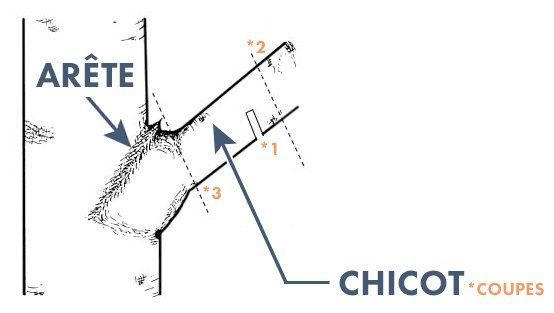
A stump is a remnant of a broken branch or trunk that protrudes from the tree. To allow the bark to close properly and prevent rot from setting in, the stump must be cut flush with the healthy part of the tree.
Sap Pull (Or Sap Call)
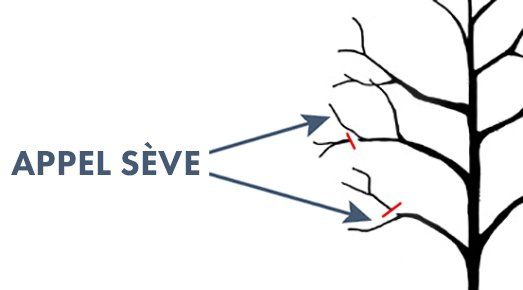
When pruning, always cut above a secondary branch so that the sap continues to flow to the end of the cut. This technique prevents the formation of dead wood and limits the appearance of suckers (excessive regrowth).
Sucker
A vigorous shoot that appears on the trunk or branches after pruning. Suckers are often poorly attached to the tree and can weaken its structure if not managed.
Crown
All the branches and foliage of a tree, i.e., the part above the trunk.
Defoliation
The loss of a tree's leaves, often caused by insects such as forest lacewings or by disease.
Dormancy
The period when the tree is dormant, usually in winter. The sap descends into the roots and the tree stops growing until spring.